Home miner · upper-mid
Canaan Avalon Mini 3
The baseboard heater that hashes at 37.5 TH/s - the one I run all winter
- Hashrate
- 37.5 TH/s
- Power
- 800 W
- Efficiency
- 21.3 J/TH
- Cost / TH
- £19
The real odds
Solo mining this against the live network, on average, finds a block about
~1 block / 479 yr
Verdict
Buy it as a heater that plays the Bitcoin lottery and it's the best-value home miner there is. Buy it as a miner and you've bought an expensive heater.
BEST FOR
- + Anyone heating a room electrically anyway
- + The best home-scale solo odds
NOT FOR
- - Summer-only spaces
- - Silent bedrooms at full tilt
Every other miner on this site asks you to justify the electricity. The Avalon Mini 3 doesn’t, because you were spending it anyway - it’s a baseboard heater that happens to hash at 37.5 TH/s while it warms the room. I run these at home, so this one’s written from the living room rather than the spec sheet.
The take
For me the Mini 3 resolved the tension every home miner page on this site keeps circling: the electricity is the whole cost, and mining almost never earns it back. Canaan’s answer is to stop pretending. This is a heater first - long, low, baseboard-shaped, app-controlled - and its 800 watts end up in your room like any resistive heater’s would. The difference is that a fan heater gives you warmth and nothing else, while this gives you warmth and roughly a 1-in-480 annual shot at a block. From November to March, mine carry the heating in the rooms they sit in, and the maths starts making a kind of sense it doesn’t make at any other time of year.
What the numbers mean
Efficiency is the wrong lens for this box. 21.3 J/TH is mid-pack - a proper datacentre Antminer does better - but the number that decides the Mini 3 is price per terahash, and here it’s around £19, the cheapest on the site by a distance. The running cost is zero if you’d have heated the room anyway. Everything hangs on that conditional: in a space you heat electrically all winter, the Mini 3 is close to a free lottery ticket at 37.5 TH/s. In a space you don’t, it’s an 800-watt appliance at UK electricity prices, and that’s roughly £4 a day. The 55 dB noise figure means conversation-level: fine in a lived-in room, wrong for a silent bedroom at full tilt, and that’s what night mode is for. Mine runs at 40 TH/s, comfortably above the 37.5 on the box, with real-world efficiency landing nearer 19 J/TH than the quoted 21.3 - but treat that as a small bonus rather than the reason to buy. The heater framing is still what makes or breaks the maths.
Living with it - noise, heat, and a closed box
Run as a heater, which is how mine live, it’s the quiet that stays with you - a low, steady hum off the long vent that you stop noticing within a day, far closer to a baseboard heater than the industrial screech people expect from an ASIC. That quiet is a big part of why I went for it over the louder, harder-edged Avalon Q. The catch is the mode. Wind it all the way to full super mode and the fans have to move real air to keep the chips healthy, so it climbs toward the rated 55 dB - the sound of a gaming PC leaning on its cooler - which is still fine in a living room or a hallway but is the wrong houseguest for a silent bedroom at full tilt. Night mode goes the other way, roughly 25 TH/s and about 430 watts, down into the low-30s dB and quiet enough to sleep beside. The read that matches my own rooms: in the heater duty most people buy it for, it’s a quiet appliance; only flat out does it announce itself, and it’s still tamer than the bigger Avalon Q.
The heat is the point, not a side effect. Nearly all 800 watts end up in the room as warmth - that’s just physics, a resistive heater is 100 percent efficient and so, in that sense, is this - and the exhaust runs warm rather than scalding, so it heats the way a baseboard unit does, steadily, off a long low vent. The clever bit is heater mode: you give it a target temperature and it throttles or pauses the hashing to hold the room there, instead of dumping 800 watts flat out whether you need them or not. Swap a 1,000-watt plug-in heater for one of these in a room you’d have heated anyway and it just quietly takes over the job, only now the electricity is buying you a lottery ticket on the side.
The catch, and it’s a real one, is that the box is sealed. The firmware is Canaan’s own - no AxeOS - and I find that very disappointing: there’s no way to control the clocks or the power limit, none of the fine-tuning you get with a Bitaxe. You get the modes Canaan ships and that’s the lot. Early units were fidgety too: a few threw error codes and dropped offline in the first weeks, and flipping between heater and mining modes could hang the thing until a firmware update sorted it. Mine have been reliable since updating, but if you buy near a launch you’re partly a beta tester, and if open firmware is half the fun of this hobby for you, the whole Avalon family will frustrate you. Setup itself is quick - the Avalon Family app walks it onto your Wi-Fi - and the same app is where you set the pool, a custom solo stratum like solo.ckpool included. What trips people up is hunting for a web login: point a browser at the miner’s IP and you get a QR pairing screen, not an admin page to type a stratum URL into.
Who should get one - and who shouldn’t
Get one if some room in your house runs on electric heat from autumn to spring - office, conservatory, garage conversion - and you’d enjoy the best home-scale solo odds going as a side effect. It’s also the obvious upgrade when a Nano 3S has charmed you and you want real hashrate: same closed-but-polished Canaan experience, six times the odds.
Don’t get one for a space that doesn’t need heating - the economics collapse entirely, and the Avalon Q conversation is the same one at double scale. And if open firmware is half the appeal of this hobby for you, the whole Avalon family will frustrate you; that’s what the Bitaxe side of the site is for.
Settings people actually run
The configs owners land on, pulled from the community. A sensible starting point, not gospel - tune to your own kit.
Mining mode (the winter default)
37.5 TH/s @ ~800 W
Full hashrate, full heat, fans ramped to hold the chips near 75C. This is the mode mine live in from November to March, and mine runs at 40 TH/s, comfortably above the 37.5 on the box.
Night mode (quiet)
~25 TH/s @ ~430 W
Throttles hashrate and fan speed together - reviewers meter it around 430 W and into the low-30s dB, quiet enough for a room you sleep in. You give up roughly a third of the hashrate for the peace.
Heater mode (thermostat)
set a target room temperature
You set a temperature and the unit throttles or pauses hashing to hold the room there, rather than blasting 800 W flat out. This is the mode that makes it behave like an actual heater instead of a miner you tolerate.
Solo lottery shot
solo pool (e.g. solo.ckpool) + your own node
37.5 TH/s is the best home-scale solo odds in our lineup - roughly 1-in-480 a year. You point it at a solo pool like solo.ckpool in the Avalon Family app; the miner's own IP only serves a QR pairing screen, so there's no separate web login to set the stratum in.
What owners report
Real first-hand experience gathered from owners and the community.
- “
I run Avalon Mini 3 units at home and the heater framing is the right one: from November to March they do the heating in the rooms they live in, and the room's warm either way - the hashing rides on electricity that was already being spent. Come summer they go off, like any heater.
- “
Wi-Fi comes via the included USB dongle; wired Ethernet needs a USB adapter that isn't in the box. Worth ordering together if you want it on the wired network.
- “
The Avalon Family app handles power modes, monitoring and the pool - a custom solo stratum like solo.ckpool goes in there, not on a web page. Point a browser at the miner's IP and you get a QR pairing screen rather than an admin login, so there's nothing to type a stratum URL into. Plenty of owners then run a third-party dashboard like Hashwatcher for per-chip temperatures and manual fan control.
- “
Early units could be fidgety - some threw error codes and dropped offline in the first weeks, and bouncing between heater and mining modes could hang the unit until a firmware update settled it. Mine have been steady since updating, but buy near a launch and you're partly a beta tester.
- “
The bottom intake has a magnetically attached filter, which sounds like a small thing until you own pets - you pull it off, knock the dust out, snap it back, no tools. Little touches like that are why the build feels like a proper appliance rather than a bare board.
4 claim(s) we couldn't fully verify
- · release_date 2025-12 (frontmatter, unchanged) - Contradicted by grounded search, which puts the unit's release earlier (early 2025 / ~2025-01) with Dec-2025 being Solo Satoshi's distributor announcement, not the launch. No clean primary Canaan first-ship date was resolved, and the owner cannot confirm one either. Value left frozen at 2025-12 and flagged here; no precise first-ship date is asserted anywhere in the prose.
- · Some third-party listings show ~1,100 W wall draw - Traced to an ASIC Miner Value spec entry; contradicts Canaan's 800 W and owner metering, which sits near 800 W in mining mode. The ~1,600 W figure belongs to the larger Avalon Q, not this unit. Kept at the 800 W spec and flagged - we'll meter ours and update.
- · Night mode ~25 TH/s / ~430 W / low-30s dB - Reviewer- and forum-metered (Vortex Bitcoin, r/BitcoinMining) via Gemini grounding, not primary-metered by us; held as reported. The mining-mode ~40 TH/s is now owner-metered (see verified). Frontmatter keeps Canaan's 37.5 TH/s nameplate; the prose carries the measured 40.
- · Early-unit firmware instability (error codes, shutdowns when switching heater/miner modes) - Sourced from Red Panda Mining's launch-window video and r/BitcoinMining threads; reported as stabilised by later firmware. Absorbed as an honest early-adopter caveat, not a current-hardware defect claim.
Hands-on reviews we drew on
We don't just copy the spec sheet. These are the teardowns and hands-on reviews behind this page - worth watching in their own right.
 ▶
▶Vortex Bitcoin
Why the Mini 3 is One of My Favorite Bitcoin Miners
 ▶
▶Red Panda Mining
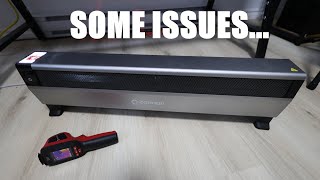
My Avalon Mini 3 BITCOIN Miner Stopped Working... a few issues!
- Canaan Avalon Mini 3: Your Home Base for Hash HeatingHashrate Index · review
- Canaan Avalon Home Series Complete Mining GuideSolo Satoshi · review
- Avalon Mini 3 - 37.5 TH/s Home Bitcoin Miner & HeaterMineshop · review
Common questions
Does the Avalon Mini 3 actually work as a heater?+
Yes - that's the design, not a marketing afterthought. It's a baseboard-shaped unit that puts its 800 watts into the room, with a dedicated heater mode and app control. In winter, mine replace resistive heating watt for watt; the hashing is a bonus on electricity I'd have spent anyway.
What are my odds of hitting a block with it?+
At 37.5 TH/s against a ~946 EH/s network, roughly a 1-in-480 chance in any given year. Far better than any desk miner, still absolutely a lottery.
How loud is it?+
Quieter than the ASIC reputation suggests. In the heater/normal duty most owners run it in (mine included) it's a low, steady hum you forget about within a day. The rated ~55 dB belongs to full super mode, where the fans work hardest - fine in a living room, wrong for a silent bedroom. Night mode drops it into the low-30s dB, quiet enough to sleep near, for about a third less hashrate.