Home miner · upper-mid
NerdOctaxe review
Eight BM1370 chips on one open-source board - the biggest Nerd miner you can put on a desk
- Hashrate
- 9.6 TH/s
- Power
- 180 W
- Efficiency
- 18.8 J/TH
- Cost / TH
- -
The real odds
Solo mining this against the live network, on average, finds a block about
~1 block / 2,000 yr
Verdict
Twice a NerdQaxe++ on one open board: around 9.6 TH/s stock and 12 on a good Rev 3.1, for a bigger solo ticket that still lives on a desk.
BEST FOR
- + NerdQaxe++ owners who want the next rung
- + Solo miners who want the most hashrate on open firmware
NOT FOR
- - First-time miners
- - Anyone expecting it to pay for itself
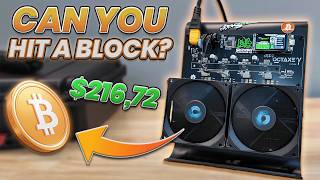
The eight-chip box on my shelf is a Zyber 8S, and sooner or later it raises the same question: what would this look like with newer silicon and firmware anyone can read? The NerdOctaxe is the open-source answer. Eight BM1370 chips, the ones Bitmain puts in the Antminer S21 Pro, on a single board with two coolers and a little colour screen. Around 9.6 TH/s on the original spec. Closer to 12 on a current Rev 3.1.
I haven’t had one on my bench, so this page leans on the vendors’ spec sheets, VoskCoin’s reviews and a handful of owners who’ve posted their real numbers. Where those disagree, I’ve said so.
The take
If you’ve run a NerdQaxe++ and enjoyed it, this is the obvious next rung, and it’s the same family in every way that matters. Same chip, same AxeOS-based firmware, same browser dashboard. Just twice as many chips and roughly twice the power, which puts it somewhere between a desk toy and a small heater. It won’t make you money. Twelve terahash is a much better lottery ticket than one, and it’s still a lottery ticket.
What I like about it is that nothing’s hidden. The board design is public, the firmware is public, and the revisions are documented well enough that you can see why the later boards run better. Compared with a closed box like the Zyber 8G (also eight BM1370s, also about 10 TH/s), you’re paying for that openness rather than for more hashrate.
What the numbers mean
Shopping for one is where the numbers stop agreeing with each other. Most shops still quote the original design’s 9.6 TH/s, which is fair enough. The wattage is where they fall apart: anywhere from 160W to 200W depending on who’s listing it, and Power Mining’s “15.0 J/TH” doesn’t survive its own 180W figure (that works out nearer 18.75). Plan the supply around 180-200W and you won’t be caught out.
The Rev 3.1 boards from Bitronics are a different animal. One owner’s first board arrived set to 700 MHz at 1.210 V and ran 11.47 TH/s at 213.5W straight out of the box, then held 12.0 TH/s at 200W once they’d dropped the voltage to 1.15 V and nudged the clock up. That’s roughly 16.7 J/TH, which is respectable for anything that sits on a desk. One owner, one board, mind. Silicon varies.
On the solo side, 9.6 TH/s against roughly 946 EH/s of network works out at about a 1-in-1,900 chance of a block in a year. At 12 TH/s it’s about 1 in 1,500. That’s eight to ten times a single Bitaxe, which is the whole point of buying one, and it’s still a number you shouldn’t build a budget on.
Revisions and the Hydro
Buy this one by revision. The Rev 3.1 redesign moved to a six-phase power stage, and that’s what owners credit for the jump to 12 TH/s and the better build quality; one owner who’d handled several NerdQaxe++ revisions rated the Bitronics boards well above the cheaper Chinese builds. Rev 3.4 adds temperature sensing on each chip and an XT60 power input. Whichever you get, it needs a proper 12V supply (vendors ship a 12V 18A brick), not anything USB.
There’s also a water-cooled Hydro version for anyone who wants it quieter, and Mineshop stocks it. I’d be careful with the overclocking chatter, too: the guidance from the community side is that the board isn’t built for heavy overclocking, and the owners getting good results are lowering the voltage rather than chasing the clock.
Who should get one - and who shouldn’t
Get one if you already run a NerdQaxe++ or a Bitaxe Hex, you know what solo mining is and isn’t, and you want the biggest open-source shot you can fit on a desk. The power draw is closer to a small heater than a gadget, so it suits a cooler room in winter better than a warm office in July.
Don’t make it your first miner. A single-chip Bitaxe teaches you everything this does for a fraction of the money, and the Bitaxe buyer’s guide sorts out which one. If the plan is profit rather than a better lottery ticket, nothing here changes the maths.
Starting settings
Starting configurations, each with where its figure comes from. A sensible starting point, not gospel - tune to your own kit.
Stock (original Gamma spec)
8x BM1370, about 9.6 TH/s at 160-180W from a 12V supply
The figure most shops quote. Power Mining lists 9.6 TH/s at 180W on a 12V 18A supply; other listings say 160W. Treat the lower wattage as best case and the 180W as what you'd plan a supply around.
Rev 3.1 out of the box
700 MHz @ 1.210 V, about 11.5 TH/s at ~213W
One owner's first Bitronics Rev 3.1 board arrived set to 700 MHz and 1.210 V and ran 11.47 TH/s at 213.5W before any tuning. That's a single owner's unit, not a spec.
Rev 3.1 tuned
740 MHz @ 1.15 V, about 12.0 TH/s at ~200W (~16.7 J/TH)
The same owner nudged the clock up and the voltage down and held 12.0 TH/s at 200W. Lower voltage is the lever worth pulling here; it trims heat and power while the clock does the work.
Solo lottery
Solo pool (public-pool, solo.ckpool or your own node)
At 9.6 TH/s against roughly 946 EH/s of network hashrate, the chance of a block is about 1 in 1,900 a year, and about 1 in 1,500 at 12 TH/s. Better than a Bitaxe by a long way. Still a lottery.
Notes from people who've run one
Each note below names its source underneath.
- “
The Bitronics-built Rev 3.1 boards are described by an owner who's handled several NerdQaxe++ revisions as noticeably better built than the cheaper Chinese builds.
- “
Rev 3.1 reaches about 12 TH/s at default-ish settings according to owners, and the six-phase power stage is the change people credit for it.
- “
It needs a proper 12V supply; vendors ship it with a 12V 18A brick. Like the NerdQaxe++, don't expect to run it from a phone charger.
- “
A water-cooled Hydro version exists for quieter running, sold by Mineshop among others.
4 claim(s) we couldn't fully verify
- · Stock power draw (160W vs 180W) and efficiency - Listings disagree: 160W (several resellers), 150-180W (Mineshop), 180W (Power Mining), ~200W (D-Central). Power Mining also states 15.0 J/TH, which doesn't follow from its own 9.6 TH/s and 180W (that's 18.75 J/TH). The page uses 180W and lets efficiency derive from it.
- · Noise around 40 dB - Only vendor figures (35-45 dB, Mineshop); no independent measurement found.
- · Original designer - Sources disagree on the community developer's handle (bitaxe.de and Solofury name different people), so the page says 'a community design' rather than naming one.
- · Hydro version hashrate (13.8 TH/s) - A single reseller's claim (Aussie Miners); left off the page.
Sources we drew on
The spec sheets, vendor pages and reviews behind this page.
 ▶
VoskCoin
The BIGGEST Mini Open Source Bitcoin Miner - 12 th/s
 ▶
VoskCoin
BIGGEST Mini Home Bitcoin Miner - NerdOctaxe Review
 ▶
VoskCoin
NerdOctaxe Gamma Review - Can You Hit A Bitcoin Block?
 ▶
WantClue
NerdOctAxe | latest revision
- NerdOctaxe Gamma 9.6 TH/s - vendor listing and spec sheetPower Mining · primary source
- NerdOctaxe Gamma Setup Guide: 8-Chip Open-Source Mining Device ConfigurationD-Central · review
- NerdOctaxe Gamma project and revision referenceD-Central · review
- Bitaxe vs Nerdaxe 2026: every model and differencebitaxe.de · review
- What Is the NerdOctaxe?Solo Satoshi · review
- Nerd* hardware family and revision listNerd* Mining Ecosystem · primary source
- Bitronics NerdOctAxe rev3.1 - first impressionsr/BitAxe · thread
- NerdOctaxe v3.1 6 phases, at 12 THr/BitAxe · thread
- NerdOctaxe Rev 3.1 Hydro - vendor listingMineshop · primary source
- Nerd*axe firmware repo - fork of Bitaxe ESP-Miner, AxeOS web UI, builds for NerdQAxe++ and NerdOCTAXEshufps / ESP-Miner-NerdQAxePlus · primary source
Common questions
Is the NerdOctaxe just two NerdQaxe++ boards?+
Close enough. It's eight BM1370 chips on one board where the NerdQaxe++ has four, running the same AxeOS-based firmware from the same open-source family. You get roughly double the hashrate and roughly double the power draw.
Does it run AxeOS?+
Yes, in forked form. It runs shufps' ESP-Miner-NerdQAxePlus, a fork of the Bitaxe ESP-Miner that keeps the AxeOS web interface and is set up the same way in a browser. If you've used a Bitaxe, the dashboard will feel familiar.
Should I overclock it?+
Carefully, if at all. Rev 3.1 boards already ship clocked well above the original 9.6 TH/s, and the guidance from the community side is that the board isn't designed for heavy overclocking. Owners who tune it tend to drop the voltage rather than chase frequency.