Mining · Guide
Bitaxe solo mining, and the odds you're taking on
Updated 18 July 2026 · about a 7 minute read
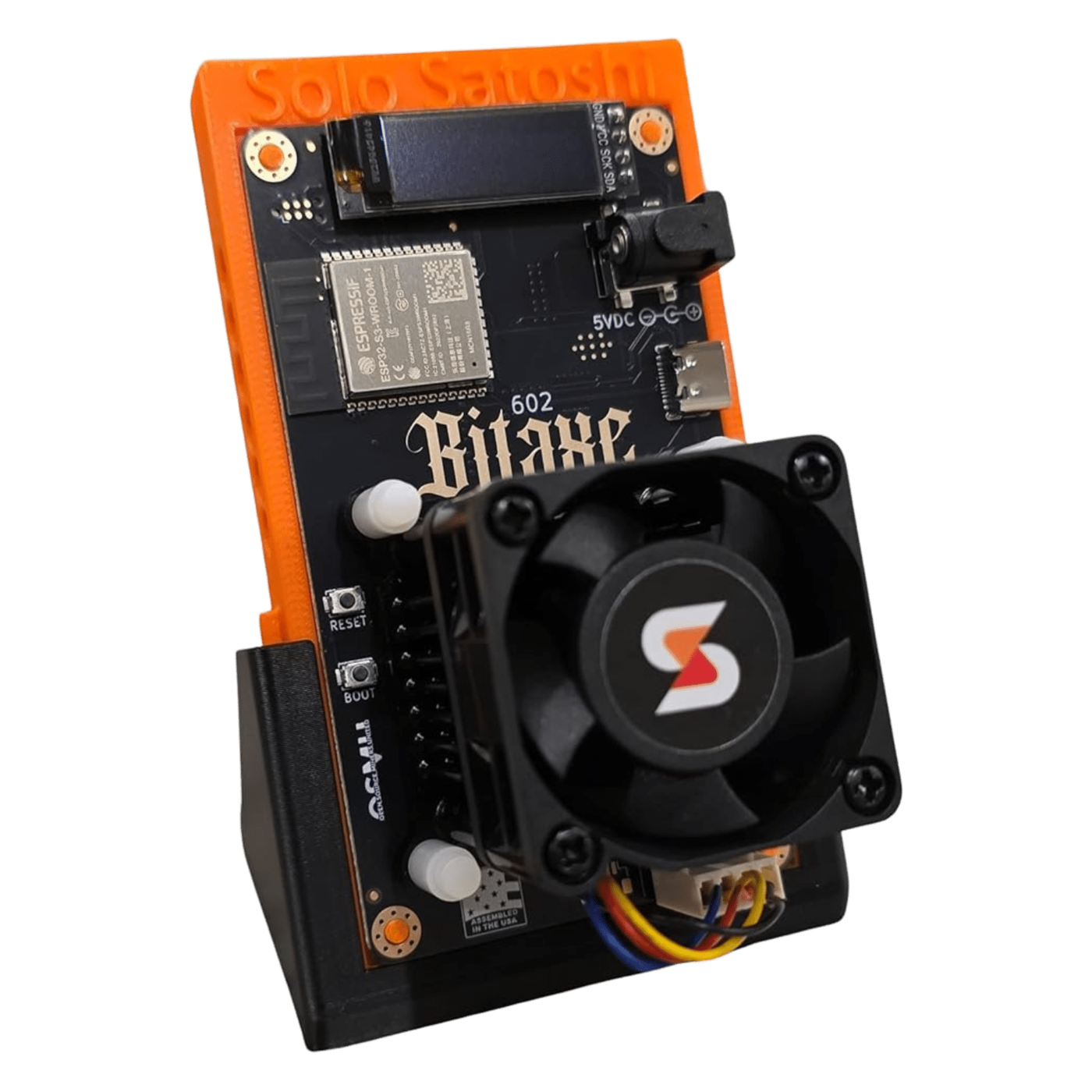
I've got a few Bitaxe-family miners on a shelf in the house. Each one is a tiny open-source board - about 15 watts, fits in your hand - throwing its hashrate at the whole Bitcoin network in the hope of a full block. Will one of mine ever win? Almost certainly not. I keep them running anyway, partly because the running cost is a lightbulb's worth and partly because setting one up taught me more about how Bitcoin works than any amount of reading.
This is the version I'd give a mate who asked. What it is, what to expect, how I'd set one up, the handful of settings that matter, and where it tends to trip people up.
What a Bitaxe is
A Bitaxe is a single-chip Bitcoin miner you can build or buy for the price of a nice night out. The popular one, the Gamma, runs the BM1370 chip - the same silicon that's inside a full-size Antminer S21 - and pushes about 1.2 TH/s while drawing roughly 18 watts. It's open-source hardware, so no single company owns it, and half a dozen small builders sell their own take on it.
It doesn't sound like a rig and it isn't one. No frame, no rows of GPUs, no dedicated circuit. It's a little board with a fan and a screen that lives on your desk, and for me that's most of the appeal - after years of full-size rigs and all the cooling grief that came with them, a miner you can pick up in one hand is a relief.
It suits people who want to understand mining by doing it, and people who like running their own gear. It is not a way to earn. If someone's selling you one as income, they're selling.
Will it ever pay?
The money question first. Solo mining means you're trying to solve a whole block on your own, and if you pull it off you get the entire reward - all 3.125 BTC of it. The catch is your slice of the network. A Gamma's 1.2 TH/s against a network measured in hundreds of exahashes is a tiny slice indeed, and the maths comes out like this:
- Network hashrate
- ~946 EH/s
- Reward if you win
- 3.125 BTC · ~£148,000
- Average time to a block
- ~1 block / 14,000 yr
Live from mempool.space, so the numbers will have shifted a little by the time you read this.
Fourteen thousand years, give or take. Two things stop that number being as mad as it looks. Luck doesn't read the average - people solo mining on a single Bitaxe have struck blocks, verifiable on-chain, and I read every one of those threads to the end. And the running cost is so small it barely registers; fifteen watts is a lightbulb. It took me a while to settle into that framing. The maths never changed, my expectations did.
What you need, and setting it up
The kit list is short.
- A Bitaxe. The Gamma is the one I'd point most people at. Want more shots in the same box? The NerdQaxe++ stacks several chips and gets you into the multi-terahash range for more money and more heat.
- A proper 5V USB-C power supply. Don't skimp here. I'll come back to this, because a bad supply is the single most common reason these misbehave.
- Wi-Fi, and a Bitcoin address to pay yourself if you ever hit.
The Bitaxe runs AxeOS, a little web interface it serves up on your network. Setup is quick - ten minutes, less if you've done it before.
- Power it on, join its setup Wi-Fi, and point it at your home network. It reboots and shows up with its own address.
- Open AxeOS in a browser. In the pool settings, put in a solo pool -
solo.ckpool.org:3333is the classic. Your username is your own Bitcoin address. That matters. It's how a win reaches you and nobody else. - Leave frequency and voltage on the stock preset for now. Watch the temperature. Only tune once you're happy it's steady.
- Check accepted shares are ticking up in AxeOS and on the pool's dashboard. Then walk away.
The levers that matter
Once it's running you'll be tempted to fiddle. There are only three knobs that count, and they all pull against each other.
Chip frequency is your hashrate dial. Turn it up and you do more work per second, which very slightly improves your already-microscopic odds. Core voltage is what feeds that frequency - push the clock and you need more volts to keep it stable. And temperature is the bill for both. More frequency and more voltage means more heat, and heat is what kills these little chips or forces them to throttle back down anyway.
So the real target isn't top hashrate, it's efficiency - the J/TH figure, joules spent per terahash. A Gamma sitting quietly around 15 J/TH is usually doing better work than the same chip cranked hot and loud for a few extra percent of hashrate you'll never feel in the odds. Find the point where it's stable and cool on the stock-ish settings, and stop. You're not going to out-tune 14,000 years.
The one lever that changes your experience is the pool, and that's worth its own paragraph. A solo pool like CKPool's solo service still mines for you - find the block, keep the reward minus a small fee - it just coordinates the work. Point it at a normal pooled address instead and you'll get tiny, regular payouts for your share of the pool's combined luck - steadier, and to my mind duller, though I can't fully defend that preference beyond liking the lottery. And fully solo, against your own Bitcoin node, cuts out the middle entirely. More setup, full sovereignty. I haven't run mine that way yet, so I can't tell you where that setup gets fiddly - it's the bit of this hobby I still owe myself.
Where it goes wrong (and how to fix it)
Almost every Bitaxe problem I've seen comes down to one of these.
- A flaky power supply. This is the big one. Random reboots, dropped hashrate, the screen cutting out - nine times in ten it's a cheap or underrated USB-C supply, not the board. Swap it for a known-good one before you suspect anything else.
- Running hot and throttling. If your hashrate quietly sags after a few minutes, the chip's got too warm and pulled itself back. Give it airflow, don't box it in, and back the frequency down a notch.
- Shares rejected, not accepted. If AxeOS shows shares being rejected, you've usually got the pool address or port slightly wrong, or the pool's fussy about the worker name. Double-check the stratum details against the pool's own page.
- The wrong payout address. The worst one, because it's silent. If you put someone else's address (or a pool-owned one) in as your username, a win pays them, not you. Check it twice. Paste, don't type.
- Wi-Fi dropping out. A weak signal where it sits will have it falling off and reconnecting all day. Move it, or get it on a better band. It won't tell you loudly, so it's worth checking if the shares look patchy.
What I'd do
Buy a Gamma. Point it at a solo pool with your own address. Leave it near stock, on a shelf with a bit of air around it, and forget about the money entirely. You'll glance at the shares now and then anyway - I still do, months in, which probably tells you something about me.